Regional Craft Markets in Germany
Germany has no single style of craft market. What you find depends heavily on region: the goods, the calendar and even the language used for the event shift as you move from the alpine south to the northern coast.

Historic craft market lane, Wallenstein festival, Memmingen. Photo: Wikimedia Commons, CC BY-SA 4.0.
The south: festival and historic markets
In Bavaria and Baden-Württemberg, craft markets are frequently woven into larger civic festivals. The Wallenstein commemoration in Memmingen, for example, sets a historic Handwerkermarkt within a wider period festival, so the stalls share the streets with costumed processions and demonstration trades.
Two features stand out in the south:
- Historic framing. Many markets adopt a period theme, with sellers presenting trades the way they would have been practised in earlier centuries.
- Demonstration trades. Turning, smithing and weaving are often shown live rather than only sold, making the market as much a public display of skill as a place to buy.
Central regions: guild and town-square markets
Through Hesse, Rhineland-Palatinate and Thuringia, the town square is the natural home of the craft market. Mainz runs a long-standing Handwerkermarkt tradition where trades such as marionette making, glasswork and other fine crafts have been presented to the public.

Marionette stall, Mainz craft market. Photo: Wikimedia Commons, CC BY-SA 4.0.
Central markets tend to lean toward fine and decorative crafts, and they often run as recurring annual events tied to a specific square or quarter of the old town.
The square is the venue: in much of central Germany the market is defined by the place it returns to year after year, not by a fixed building.
The north: harbour, farm and weekly markets
Northern Germany puts more weight on the working market. Farm and produce markets — such as direct-sale markets at rural estates — sit alongside craft pitches, and the everyday Wochenmarkt remains the backbone of market life in many towns.
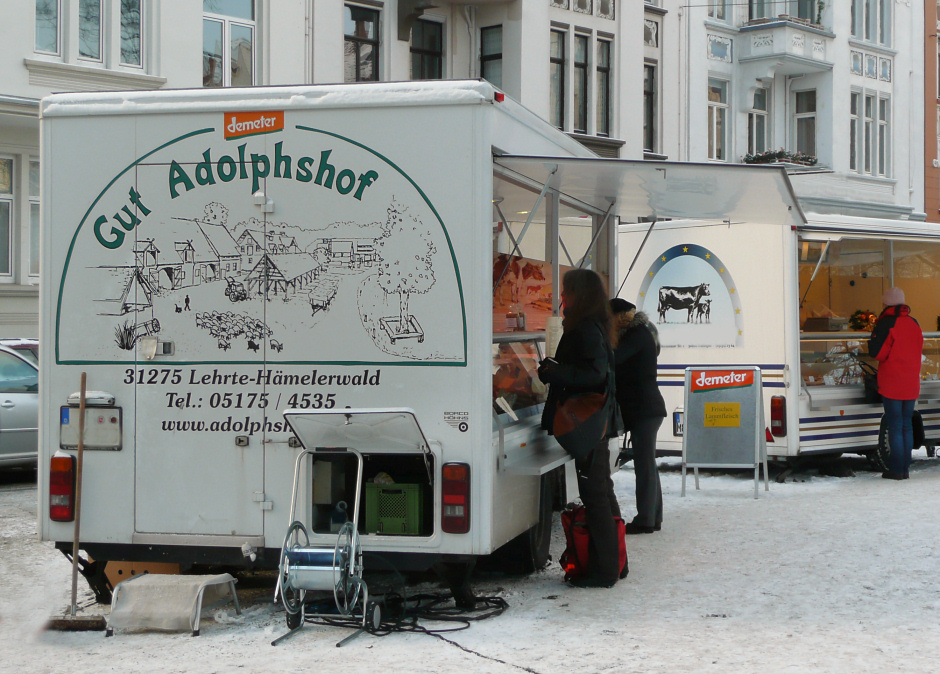
Farm market at Adolphshof, Lower Saxony. Photo: Wikimedia Commons, Public domain.
Crafts in the north often appear as part of these broader markets or at seasonal events, rather than as standalone historic festivals on the southern model.
Choosing a market to visit
A simple way to plan:
- Decide what you want to see — live demonstration trades point you south; fine and decorative crafts point you to central town squares; produce and direct-sale goods point you north.
- Check the format — a historic festival, a recurring town-square market, or a weekly market embedded in daily life.
- Match it to the season — most standalone craft and historic markets cluster in the warmer months and Advent.
For the timing side of this, see the companion guide to the seasonal fair calendar. To understand the stalls themselves, read how artisan stalls operate.